The knee stopped hurting six weeks ago. The surgeon said the repair looks excellent. You have been cleared, technically, and yet the first time you jog on a curve or plant to change direction, something is off in a way that is hard to put into words. The leg holds up. It just does not feel like it belongs to the same athlete it did last season. This is one of the most common and least discussed moments in recovery, and it is exactly where a gait analysis earns its place. Pain resolving and movement returning to normal are two separate events, and they do not happen on the same schedule.
TL;DR: A gait analysis breaks your walking and running mechanics down into measurable pieces so compensations that persist after pain resolves can be identified and corrected. Combined with strength and hop testing, it turns return-to-sport clearance into a decision based on what your body can actually do rather than on how many weeks have passed since the injury. See how it fits into our physical therapy for sports injuries in Pembroke Pines.
What Is Gait Analysis, and Why It Matters for Recovery
Gait analysis is the systematic assessment of how you walk and run, broken into measurable components: foot strike, stride length, cadence, hip and pelvic control, and how load is shared between limbs. In a rehabilitation setting, its purpose is not to make you faster. It is to expose the compensations your body adopted while injured and quietly kept.
That habit-forming is the part patients underestimate. A moderately active person walking around 7,500 steps a day accumulates well over two hundred million steps in a lifetime. When you spend six weeks unloading one leg because it hurts, you are not just resting it; you are rehearsing a new movement pattern thousands of times a day. The pain leaves. The rehearsal stays. Compensatory patterns also carry a real energy cost, with gait abnormalities reported to increase energy consumption anywhere from roughly 3% to 33% depending on which joint is compensating.
At Healers of Motion Physical Therapy in Pembroke Pines, Dr. Evelyn Mora, DPT, brings a background most outpatient clinics do not have to this kind of assessment. Before founding the practice, she worked as a physical therapist for professional soccer teams in Colombia, where clearing a player to return was never a matter of counting weeks. It meant demonstrating, on video and under load, that the mechanics had actually come back. That standard is the one applied here, whether the athlete is a college midfielder or a fifty-year-old who plays pickleball four mornings a week.
Return to Play Testing: How We Know an Athlete Is Ready
Return to play testing is a battery of objective measures compared side to side, rather than a single test or a date on the calendar. It typically combines strength symmetry between limbs, single-leg hop distance and control, movement quality under fatigue, gait and running mechanics, and the athlete’s own confidence in the limb.
The reason it exists is that the alternative fails predictably. Calendar-based clearance asks how long it has been. Criteria-based clearance asks what you can do. Those questions produce different answers surprisingly often, because a limb can regain strength while retaining poor control, and control is what governs the split second when a knee has to decelerate and rotate at the same time.
| Calendar-Based Clearance | Criteria-Based Clearance | |
| Central question | How many weeks since the injury or surgery? | What can this limb currently do compared with the other one? |
| Evidence used | Elapsed time, absence of pain, imaging | Strength symmetry, hop batteries, gait and landing mechanics, fatigue response |
| What it can miss | Persistent compensation, single-leg control deficits, asymmetric loading | Little, when the battery is comprehensive and repeated |
| Typical failure mode | Athlete returns while still compensating | Athlete returns later than they hoped |
| Documentation produced | A date | Measurable data that can be shared with a surgeon or coach |
One concept worth knowing by name is the limb symmetry index, which simply expresses what the involved limb can do as a percentage of the uninvolved side. It gets applied to strength measures and to hop tests. Commonly used thresholds sit around 90% or higher before full clearance, though the specific target depends on the injury, the sport, and the surgeon’s protocol.
Alongside the symmetry work, a Functional Movement Screen looks at foundational patterns such as a deep squat, a lunge, and single-leg stability to find what we describe on our service pages as biomechanical energy leaks: places where force is being lost or misdirected before it reaches the ground.
What Physical Testing Looks Like During a Session
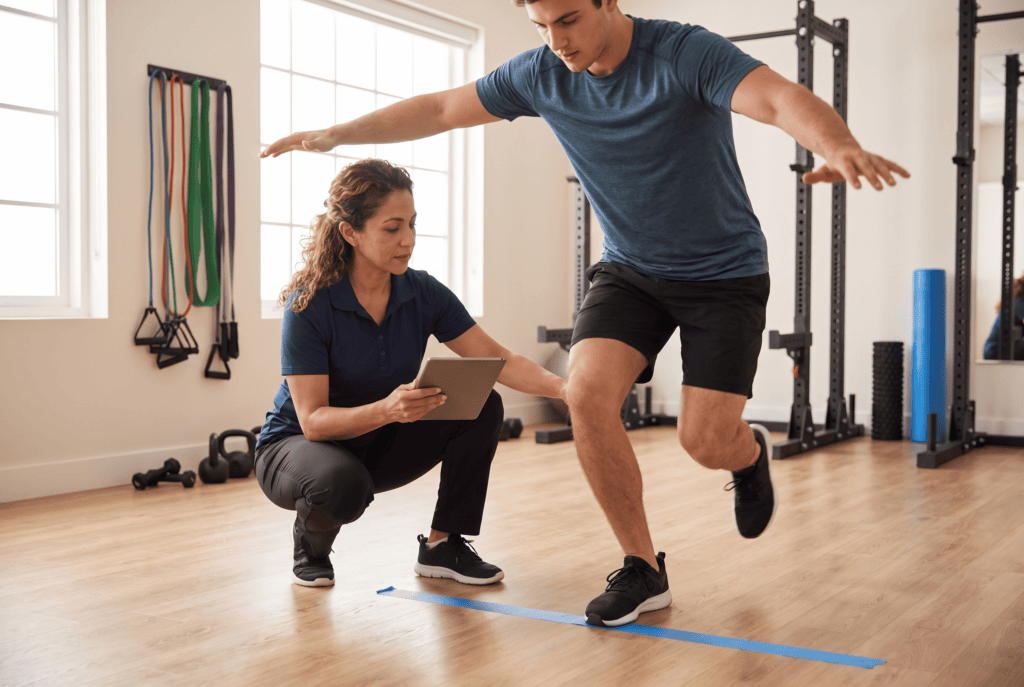
Physical testing in a gait analysis session generally runs about an hour and moves from static to dynamic. You are observed standing, then walking, then running if that is appropriate for your stage, usually with video captured from the front, side, and behind so slow-motion review is possible.
A typical sequence looks like this:
- History and goals. What sport, what surface, what position, and what specifically feels wrong. This shapes what we watch for.
- Static and mobility screening. Foot alignment, ankle range, hip rotation, single-leg balance. Restrictions here explain a lot of what shows up later in motion.
- Walking assessment. Video capture and observation of foot strike, step width, pelvic level, and whether one limb is spending less time in stance than the other.
- Running or sport-specific movement. Cadence, stride length relative to your center of mass, trunk position, hip drop, and knee alignment through stance.
- Strength and hop testing. Side-to-side comparison, ideally repeated after fatigue, because clean mechanics on a fresh limb tell you less than mechanics in the ninetieth minute.
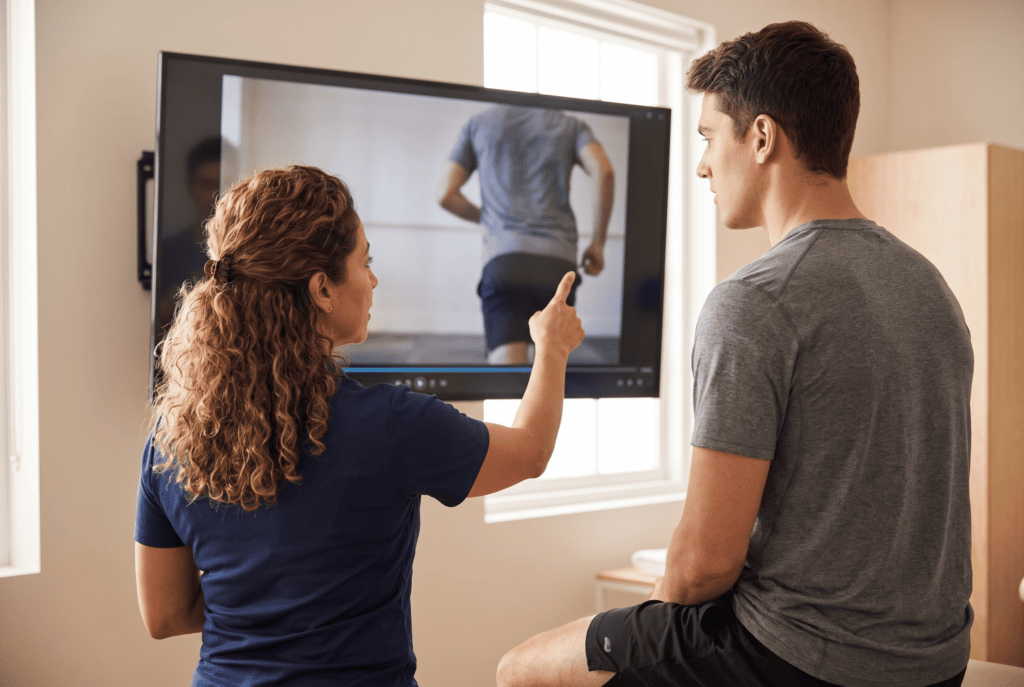
- Video review with you. Watching your own hip drop in slow motion communicates more in fifteen seconds than a paragraph of description.
- The plan. Specific corrective work, cueing, and a re-test date.
The patterns that turn up most often have names. Overstriding is landing with the foot ahead of your center of mass, which increases braking force through the knee. Crossover is the foot landing across the midline rather than under the hip, which usually reflects a hip stability or trunk control deficit. Hip drop is the opposite side of the pelvis dipping during single-leg stance, and after a lower-limb injury it is one of the most reliable tells that stabilizing strength has not fully returned.
Physical Therapy for Sports Injuries
Return to Your Sport on Objective Criteria, Not Guesswork
Dr. Mora worked with professional soccer teams in Colombia before bringing that approach to Pembroke Pines. Gait analysis and Functional Movement Screening help us find the biomechanical gaps that tend to send athletes back too soon.
Why Athletes in Recovery Benefit From Movement-Based Assessment
Athletes in recovery benefit from movement-based assessment because it measures the thing that actually correlates with reinjury: how the limb behaves under load. Strength testing alone can look reassuring while landing mechanics remain asymmetric, and it is the landing, cutting, and decelerating that place the highest demand on healing tissue.
There is a second benefit that gets less attention. Being shown your own video is often the moment the recovery stops feeling arbitrary. An athlete who has been told to “keep doing your exercises” for four months without knowing why tends to disengage. An athlete who watches their right hip drop three centimeters more than their left, then watches it improve on a re-test six weeks later, has something concrete to work toward. Confidence in a limb is a legitimate clinical variable, not a soft one, and objective data is one of the more reliable ways to rebuild it.
It is also useful for the people co-managing your recovery. A surgeon or coach asking whether an athlete is ready is better served by symmetry percentages and video than by a therapist’s impression. For patients whose recovery began with an operation, our physical therapy for surgical recovery in Pembroke Pines page covers the earlier stages that precede this kind of testing, including how post-surgical neural inhibition is addressed before movement testing is meaningful.
Beyond Clearance: Moving Better for the Long Term
Clearance is a milestone, not a finish line. The mechanics that show up in a gait analysis after an injury are frequently the same mechanics that contributed to it, which means correcting them is prevention as much as rehabilitation. An athlete who returns to sport with the compensations intact has resolved the pain and kept the cause.
This is why we treat a re-test as part of the plan rather than an optional extra. Patterns drift under fatigue, across a season, and as training loads change. Re-checking at intervals, or after a change in sport, surface, or footwear, catches drift while it is still a cueing problem rather than an injury. It is the same logic behind seeing a physical therapist annually for movement screening rather than only after something tears.
A gait analysis will not make a slow athlete fast, and it is not a substitute for the strength and progressive loading work that rebuilds tissue capacity. What it does is replace guesswork at the most consequential decision in the whole recovery: whether you are ready. If you are an athlete or an active adult in Pembroke Pines, Weston, Miramar, Southwest Ranches, or Davie who has been cleared on paper but does not feel cleared, a gait analysis and a round of return to play testing will tell you where you actually stand. Call us at 954-861-0252 to talk it through.
Frequently Asked Questions
Plan on about an hour for a full assessment. That covers history and goals, static and mobility screening, walking and running video capture, strength and hop testing where appropriate, and time to review the footage together and build the corrective plan. Follow-up re-tests are usually shorter.
No. Anyone whose walking or running mechanics have changed after an injury, a surgery, or years of a compensation pattern can benefit. Recreational runners, pickleball and tennis players, and adults recovering from a joint replacement are all common candidates, not just competitive athletes.
Wear athletic clothing that leaves the knees and ideally the hips visible, since the assessment depends on seeing joint motion. Bring the shoes you actually train or compete in, plus any older pair you have been using, because wear patterns and footwear differences often explain part of what shows up on video.
It cannot eliminate risk, but it can identify the compensations and asymmetries associated with higher reinjury risk, so they can be addressed before you return to full load. Correcting the mechanics that contributed to an injury is one of the more useful things rehabilitation can do beyond settling the pain.
Surgical clearance and functional readiness answer different questions. Your surgeon is confirming the repair is healing and the joint is stable, which is their domain. Strength symmetry, single-leg control, and landing mechanics are measured separately, and physical therapy is where that testing happens.
Nothing punitive. A result below the target simply identifies which measure is lagging, whether that is quadriceps strength, hop symmetry, or control under fatigue, and that becomes the focus of the next block of training before a re-test. It is information, not a verdict.
It is typically performed as part of a physical therapy evaluation or treatment session, which many plans cover, though specifics vary considerably. Call our office at 954-861-0252 before scheduling and we will help you confirm what your plan includes.