
The first genuinely alarming moment after ACL reconstruction surgery usually has nothing to do with pain. It is the moment you try to straighten your leg or tighten your thigh, and the muscle simply does not answer. The knee feels borrowed. Patients describe it as their quad being disconnected, or as though the signal is not getting through, and most of them quietly assume something went wrong in the operating room. Almost always, nothing did. A swollen knee sends a reflex signal that dampens the quadriceps’ ability to contract fully, and that shutdown is one of the first things rehabilitation is built to reverse. Understanding what each stage of recovery is actually working on makes the whole timeline far less unsettling.
TL;DR: Recovery after ACL reconstruction surgery runs in stages, not on a single countdown. Early weeks focus on controlling swelling, restoring full knee extension, and waking the quadriceps back up. Middle months build strength and single-leg control. The final stage is earned through objective testing rather than a date on the calendar, which is why criteria-based clearance matters more than the month you are in. Learn how our physical therapy for surgical recovery in Pembroke Pines supports each stage.
Understanding ACL Reconstruction Surgery and Why Rehab Matters
ACL reconstruction surgery replaces a torn anterior cruciate ligament with a graft, usually taken from your own hamstring tendon, patellar tendon, or quadriceps tendon. The operation restores the knee’s passive restraint. What it cannot restore is the muscle control and joint awareness that were lost, and rebuilding those is entirely the work of rehabilitation.
At Healers of Motion Physical Therapy in Pembroke Pines, Dr. Evelyn Mora, DPT, approaches this through Neuromuscular Re-education and Proprioceptive Training, aimed squarely at a problem called Neural Inhibition. Neural inhibition is a temporary loss of full voluntary muscle contraction after surgery, and it happens because a swollen, irritated joint sends signals that reflexively reduce the nervous system’s drive to the surrounding muscle. The quadriceps after a knee procedure is the textbook example. That is the reason “just do your quad sets” is incomplete advice: if the joint is still swollen, the muscle is being neurologically held back, and controlling the swelling is what unlocks the contraction.
This is also where the sequence of an anterior cruciate ligament reconstruction rehab plan earns its keep. Push strength work before extension range and swelling are addressed, and you build strength into a movement pattern the knee cannot yet perform correctly. Because every session here is delivered one-on-one by a Doctor of Physical Therapy rather than handed to an aide between sets, the progression is adjusted to what your knee is doing that week rather than to what week it happens to be.
What to Expect in the First Weeks After Anterior Cruciate Ligament Reconstruction Surgery
The first two to six weeks after anterior cruciate ligament reconstruction surgery are about three things: reducing swelling, restoring full knee extension, and reactivating the quadriceps. Full extension is prioritized early because a knee that stiffens short of straight is far harder to correct later than a knee that is slow to bend.
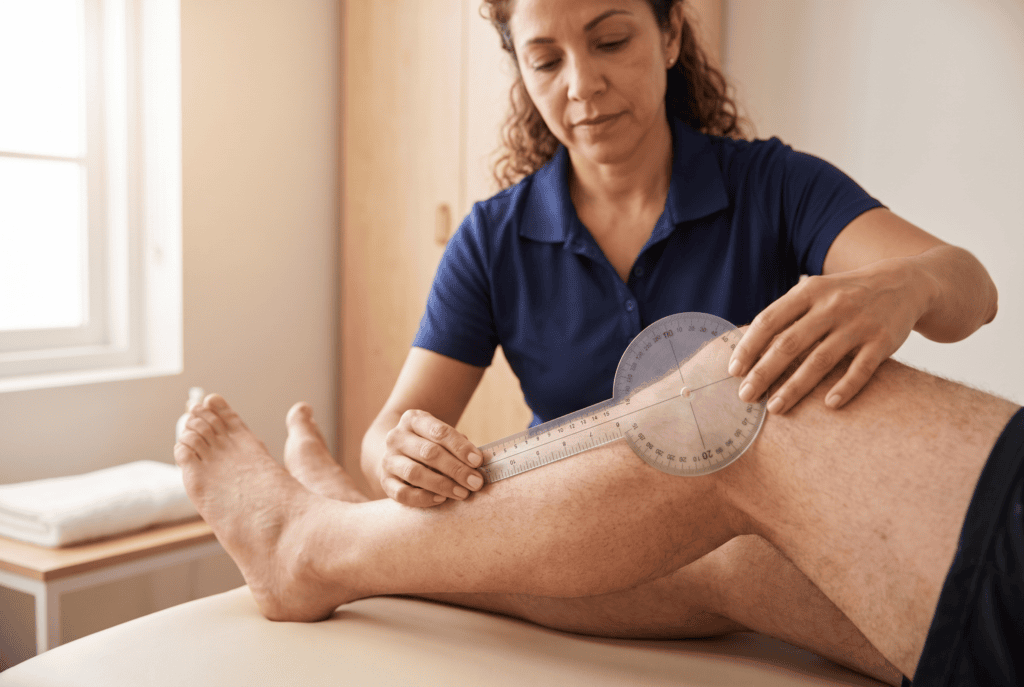
Expect crutches and a brace for a period your surgeon determines, along with icing and elevation that will feel repetitive and matters more than it seems. Common early goals include getting the knee to lie flat at zero degrees of extension, working flexion toward roughly 90 to 100 degrees in the first couple of weeks, and being able to perform a straight leg raise without the knee sagging into a lag. Your surgeon sets your specific weight-bearing and bracing restrictions, and we build the sessions inside those limits rather than around them.
Two things surprise patients most in the early weeks after ACL reconstruction surgery. The first is how much of the work is small and unglamorous: quad sets, heel slides, ankle pumps, patellar mobility. The second is how quickly swelling undoes progress. A knee that swells after an ambitious afternoon will often lose extension range and quad activation by the next morning, which is why we pace the early weeks deliberately.
ACL Surgery Recovery Time: A Phase-by-Phase Timeline
ACL surgery recovery time typically spans nine to twelve months before return to competitive cutting and pivoting sports, though walking, driving, and daily activity return far sooner. The timeline is best understood as a sequence of gates you pass by meeting criteria, not a schedule that advances on its own.
The biology of the graft explains part of the pacing that follows ACL reconstruction surgery. A new graft is at its strongest the day it is fixed in place, then goes through a remodeling process in which it weakens before it rebuilds into ligament-like tissue. That is a genuine biological reason why feeling good at three months is not the same as being ready at three months.
| Phase | Typical Window | Primary Focus | Common Gate to Advance |
| Protection and activation | Weeks 0 to 6 | Swelling control, full extension, quad reactivation | Knee flat at 0 degrees, straight leg raise without lag |
| Strength foundation | Weeks 6 to 16 | Progressive loading, gait normalization, single-leg control | Roughly 70% strength symmetry side to side before running |
| Power and agility | Months 4 to 8 | Plyometrics, deceleration, change of direction | Around 85% strength symmetry, controlled landing mechanics |
| Return to sport | Months 9 and beyond | Sport-specific drills, contact exposure, confidence | Approximately 90 to 95% symmetry across a hop and strength battery, plus psychological readiness |
Graft choice shifts the emphasis too. A hamstring autograft tends to leave both early quadriceps weakness and lingering hamstring donor-site weakness to address, while patellar and quadriceps tendon grafts front-load anterior knee and quad deficits. Same surgery name, meaningfully different rehab emphasis, which is one more reason a generic downloaded protocol is a poor substitute for an assessed plan.
How Physical Therapy Supports You in Recovering From ACL Surgery
Physical therapy supports recovering from ACL surgery in three overlapping layers: restoring the joint’s mechanics, retraining the nervous system’s control of the muscles around it, and rebuilding the ability to absorb load at speed. Each layer depends on the one before it, which is why the order of a rehab plan matters as much as its content.
Restoring mechanics comes first: manual therapy for the joint and surrounding soft tissue, patellar mobility work, and range of motion progression toward full extension and flexion. Retraining control is the neuromuscular re-education piece, and it is where proprioceptive training does the heavy lifting. Proprioception is your body’s sense of where a joint is in space without looking at it, and ACL injury damages it, because the ligament itself carries sensory receptors that fed that information to the nervous system. Losing them is why a knee can test strong and still feel untrustworthy on uneven ground.
Rebuilding load capacity is the final layer: single-leg strength, deceleration, landing mechanics, and change of direction. It is also the layer most often shortchanged after ACL reconstruction surgery. An athlete who can squat well but cannot land on one leg without the knee drifting inward has strength without control, and that combination is precisely what tends to show up in reinjury patterns.
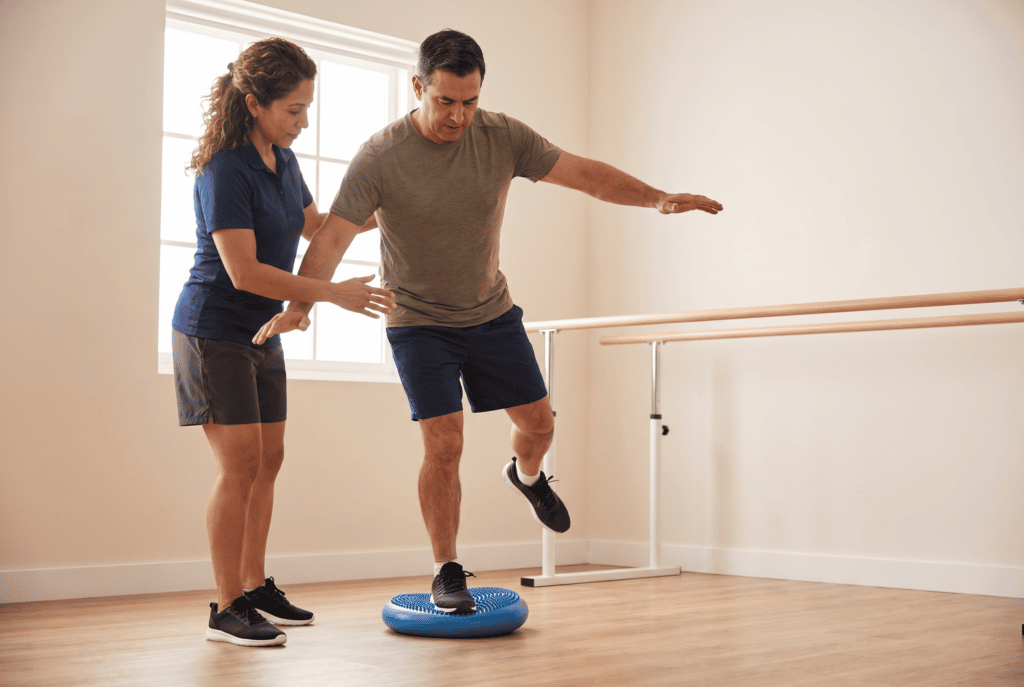
Because our approach to physical therapy for sports injuries uses objective movement testing rather than time alone, the transition from rehabilitation to performance is measured rather than assumed. If your knee also has ongoing mechanical irritation beyond the graft itself, our joint pain therapy in Pembroke Pines addresses those contributing factors alongside the surgical recovery.
Signs You Are Progressing Well, and When to Loop in Your PT
Good progress after ACL reconstruction surgery looks like a knee that stays quiet after activity, extension that holds from one week to the next, a quadriceps that visibly contracts on command, and a gait pattern that stops looking protective. Those four signs together generally matter more than how far along the calendar you are.
Encouraging signs to look for:
- Swelling that settles overnight rather than accumulating across the week
- Full, symmetrical knee extension that does not need to be re-earned every session
- A quad contraction you can produce and hold without the joint aching
- Walking without a limp, without conscious effort, on level ground
- Confidence returning gradually, which is a legitimate clinical marker rather than a soft one
Loop your physical therapist in promptly if the knee swells and stays swollen, if extension range starts moving backwards, if you notice new instability, catching, or locking, or if pain shifts from the diffuse soreness of rehabilitation to something sharp and localized. Calf pain or swelling, fever, or increasing redness around the incision warrant a same-day call to your surgeon.
Surgical Recovery
The Surgery Is Done. The Rebuilding Starts Here.
After a joint replacement, ACL or rotator cuff repair, or spinal surgery, muscles are often slow to fire again. Neuromuscular re-education and proprioceptive training are designed to restore that connection step by step, at a pace your body can handle.
Recovery from ACL reconstruction surgery is genuinely long, and the part most patients find hardest is that feeling ready and being ready arrive months apart. That gap is not a sign of slow progress; it is the reason objective testing exists. If you are recovering from a knee reconstruction in Pembroke Pines, Weston, Miramar, Southwest Ranches, or Davie and want a plan built around your knee rather than a generic protocol, our team is glad to talk it through. Call 954-861-0252.
Frequently Asked Questions
Most patients return to daily activity within a few weeks and to running in the middle months, while return to cutting and pivoting sports is commonly nine to twelve months out. The wide range reflects graft type, surgical technique, and how the knee responds, so your surgeon and physical therapist set your specific pace.
A swollen or irritated knee joint reflexively reduces the nervous system’s signal to the quadriceps, a phenomenon called neural inhibition. The muscle is not damaged; its activation is temporarily suppressed. Controlling swelling and using targeted activation work is what restores the contraction, which is why early swelling management is not optional.
That depends on which leg was operated on, whether you drive an automatic, whether you are still using narcotic pain medication, and your surgeon’s clearance. Many patients with a left-knee surgery and an automatic transmission return sooner. Your surgeon makes this call, not your physical therapist.
Yes. Hamstring grafts commonly leave hamstring donor-site weakness to rebuild alongside the quad, while patellar and quadriceps tendon grafts tend to concentrate early deficits in the front of the knee. The overall stages are similar, but the emphasis within each stage shifts based on where tissue was taken.
Readiness is assessed rather than dated. We look at strength symmetry between limbs, single-leg hop and landing quality, movement control under fatigue, and your own confidence in the knee. Meeting those criteria matters more than reaching a particular month, because reinjury risk tracks with movement quality rather than the calendar.
An excellent surgical result and a fully rehabilitated knee are two different things. Imaging and joint stability testing tell your surgeon the graft is doing its job. They do not measure quadriceps activation, single-leg control, or landing mechanics, and those are what physical therapy is designed to rebuild.
Often, yes. Lingering strength asymmetry, altered movement patterns, and proprioceptive deficits can persist long after a knee stops hurting, and they respond to assessment and targeted retraining. A movement evaluation is a reasonable starting point even years out from the original procedure.