Two assumptions tend to walk into the room ahead of laser therapy. The first is that it will feel like something: heat, tingling, a jolt. Most patients feel almost nothing, and quietly conclude nothing happened. The second is the opposite problem, the hope that a light-based treatment is the one thing that will finally settle a shoulder or a heel that has been aching for eight months while everything else has been tried. Neither assumption is quite right, and the gap between them is where most of the confusion about this treatment lives. It is a real, measurable intervention that works at the level of cellular energy production, and it works best as one part of a plan rather than the whole of it.
TL;DR: Laser therapy uses specific red and near-infrared wavelengths to stimulate energy production inside cells, which supports reduced inflammation and pain in the treated tissue. Sessions are brief and typically painless, and most patients need a short series rather than a single visit. It works best as an adjunct that opens a window of reduced pain in which manual therapy and progressive exercise do the lasting work. See how it fits into our joint pain therapy in Pembroke Pines.
What Is Laser Therapy, and How Does It Work?
Laser therapy, also called photobiomodulation or low-level laser therapy, is the therapeutic use of specific red and near-infrared wavelengths to influence cellular activity in the tissue underneath. It does not cut, burn, or heat tissue the way a surgical laser does. It delivers light at a dose meant to change how cells use their own energy.
The mechanism is more specific than most explanations suggest. Inside nearly every cell sit mitochondria, and inside the mitochondrial respiratory chain sits an enzyme called cytochrome c oxidase. It absorbs light in the red and near-infrared range, and when it does, the cell’s production of adenosine triphosphate, or ATP, increases. ATP is the currency cells spend on repair. Injured, inflamed, or poorly perfused tissue is often running an energy deficit, and photobiomodulation is designed to relieve that deficit rather than to mask the symptom sitting on top of it.
At Healers of Motion Physical Therapy in Pembroke Pines, Dr. Evelyn Mora, DPT, uses laser therapy as one modality inside a broader Kinetic Chain Assessment approach. That assessment matters more than the device does. Knee pain frequently traces back to hip instability or restricted ankle mobility, and treating the painful knee with light while leaving the hip unaddressed produces short-lived relief. The light buys a window. The assessment decides where to point it and what to do inside that window.
How Laser Pain Treatment Reduces Inflammation and Discomfort
Laser pain treatment reduces discomfort through several overlapping effects rather than a single one: increased cellular ATP production, improved local circulation, reduced inflammatory signaling in the treated tissue, and a dampening of pain transmission from the nerve endings in the area. The combined result is typically a measurable drop in pain sensitivity and swelling over a series of sessions.
A few practical points about dosage that most articles skip entirely. The depth of the tissue you are treating determines the wavelength and power needed to reach it, which is why a superficial tendon and a deep hip joint are not treated with the same settings. Longer near-infrared wavelengths, generally above 800 nanometers, penetrate deeper than visible red light. And dose matters in both directions: too little energy delivered to the target tissue produces no meaningful effect, and there is no benefit in simply turning the power up indefinitely. Getting the dose right for the specific structure is the clinical skill, not owning the machine.
This is also the honest limit of the treatment. Reducing inflammation and pain sensitivity in a tissue does not correct the movement pattern that overloaded it. That is why we treat laser pain therapy as something that creates an opportunity, not as a standalone answer.
Physical Therapy Laser Treatment: What a Session Looks Like
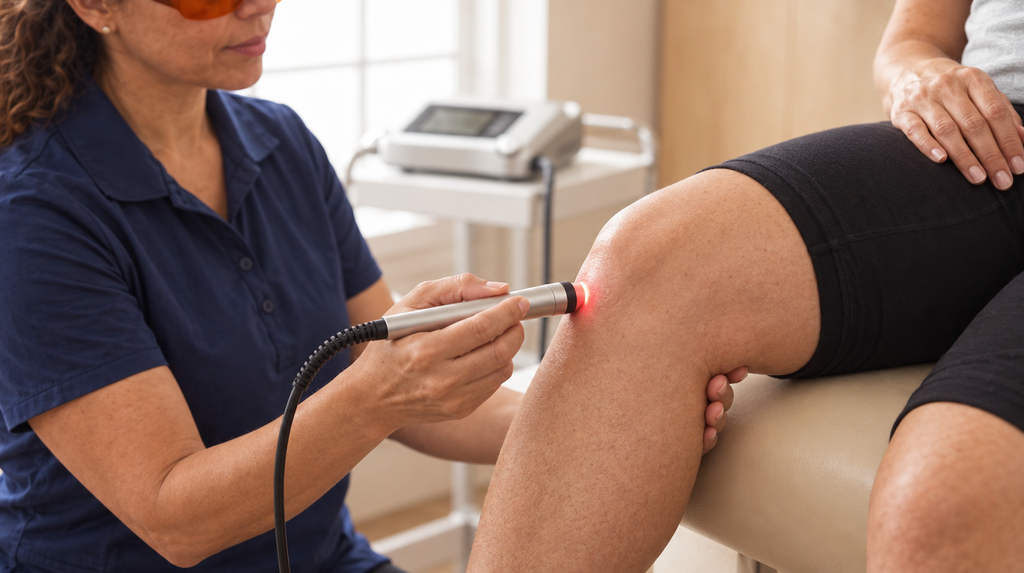
A physical therapy laser treatment session is short, quiet, and undramatic. Both of you wear protective eyewear, and the handpiece is moved slowly across the target area for a few minutes. Most patients report feeling nothing at all, or a faint warmth. Nothing is inserted, and there is no recovery time afterward.
Here is the typical sequence within a visit:
- Assessment first. Range of motion, strength, and movement quality are checked so there is a baseline to measure against, and so the target tissue is chosen deliberately.
- Setup. Protective eyewear for everyone in the room, and the skin over the target area exposed, since clothing and lotion interfere with light transmission.
- Application. Usually several minutes per area, with the handpiece kept in slow motion rather than held in one spot.
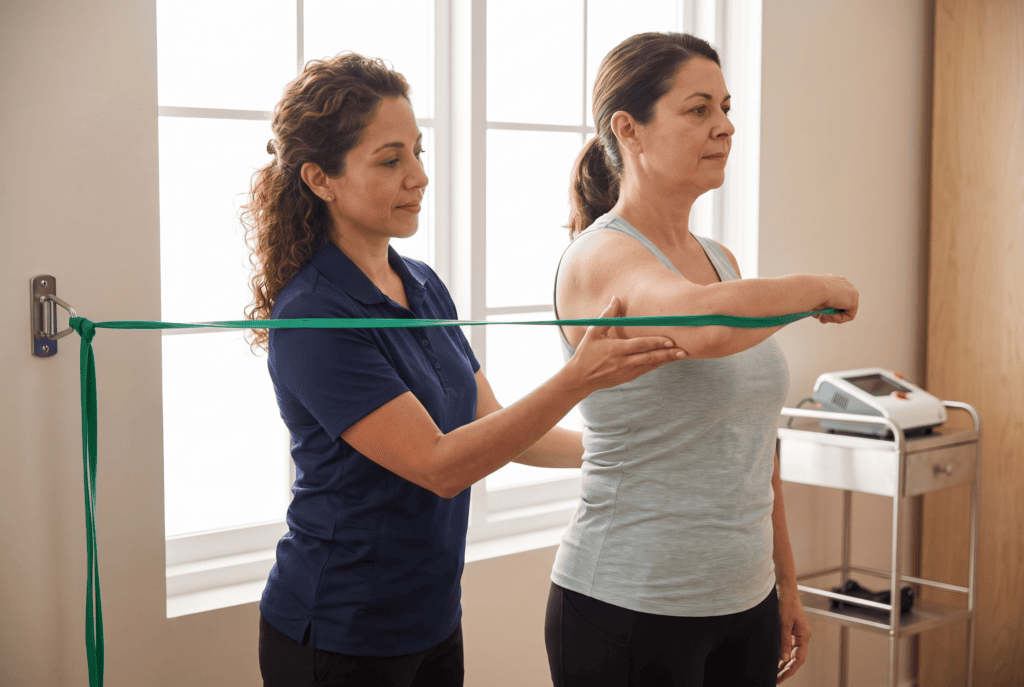
- The rest of the session. Manual therapy, dry needling where it is indicated, and the exercise progression that actually rebuilds the tissue’s capacity.
- Home program. What you do between visits determines a large share of the result.
That order is deliberate. Because every session is delivered one-on-one by a Doctor of Physical Therapy, the laser is applied in the same visit as the hands-on and exercise work rather than in a separate passive appointment. Passive treatment on its own tends to feel good and change little.
A short note on safety, since almost no article on this topic includes one. Laser is generally avoided directly over a known or suspected malignancy, over the abdomen during pregnancy, over the thyroid, directly into the eyes, and in some cases over implanted electronic devices. Certain medications increase light sensitivity as well. Those are screening questions we ask before treating, and they are worth raising with any provider offering this treatment. [verify PAA/FAQ phrasing]
Joint Pain Therapy
Your Knee Pain May Not Start at Your Knee
We use a Kinetic Chain Assessment to look above and below the joint that hurts, because restricted ankle mobility or hip instability often shows up as knee pain. Manual therapy, laser therapy, and dry needling support the plan from there.
Conditions That Respond Well to Laser Pain Therapy
Laser pain therapy is most commonly used for painful, inflamed soft tissue and joint conditions where reducing local inflammation makes progressive loading possible. Tendon problems, plantar fascia pain, arthritic joint irritation, and post-surgical soft tissue healing are among the most frequent applications in an outpatient physical therapy setting.
Conditions we most often pair it with include:
- Tendinopathy at the shoulder, elbow, hip, knee, or ankle, including tennis and golfer’s elbow
- Plantar fasciitis and heel pain, where the tissue is superficial and easy to target accurately
- Arthritic joint pain in the knee, hip, or hand, as part of managing irritation rather than the underlying joint changes
- Post-surgical soft tissue healing, coordinated with your surgeon’s restrictions
- Neck and upper back pain with an inflammatory component
- Overuse injuries in active adults who need irritation settled before load can be rebuilt
| Tool | What It Targets | What the Patient Feels | Role in the Plan |
| Laser therapy | Cellular energy production and local inflammation | Usually nothing, sometimes faint warmth | Lowers irritation so loading becomes tolerable |
| Functional dry needling | Deep myofascial trigger points and inhibited muscle activation | A brief twitch or ache in the muscle | Resets neural input to muscles guarding a joint |
| Manual therapy | Joint and soft tissue mobility restrictions | Pressure, stretch, occasional soreness after | Restores available range so exercise is productive |
| Therapeutic exercise | Strength, control, and load capacity | Effort and normal training fatigue | Builds the durable change that holds after discharge |
If your pain has a strong muscular trigger-point component alongside the inflammatory one, our dry needling in Pembroke Pines page explains how that tool differs and when we combine the two.
What to Expect From Your Results Over Time
Most patients notice a change across a series of sessions rather than after one. Some feel a difference within the first two or three visits, others need a longer course, and a minority do not respond at all. Sessions are brief, often five to ten minutes per area, with a course commonly running several visits over a few weeks.
What changes first is usually irritability: the tissue tolerates more before it complains. That is the practical signal that the window has opened. From there, the exercise progression is what converts a quieter tissue into a stronger one, and it is the part that determines whether the relief holds three months later. Anyone promising a guaranteed outcome or a fixed number of visits from a treatment like this is describing marketing rather than physiology.
We are also straightforward about what it is not. It is not a substitute for addressing why a tissue became overloaded, it is not a reason to skip the strengthening work, and it does not replace a conversation with your physician about a condition that needs medical management. For active adults dealing with recurring overload rather than a single injury, our physical therapy for sports injuries approach looks at the mechanics behind the pattern.
Used well, laser therapy is a quietly useful tool: brief, comfortable, and aimed at the cellular level of tissue repair rather than at masking a symptom. Used alone, it tends to disappoint. If you have a stubborn joint or tendon problem in Pembroke Pines and want to know whether laser therapy belongs in your plan, an assessment is the place to start. Call our office at 954-861-0252 or read more about our joint pain therapy in Pembroke Pines.
Frequently Asked Questions
Almost never. Most patients feel nothing at all, and some report a faint warmth over the treated area. There are no needles and no incisions, and there is no recovery period afterward. Protective eyewear is worn during treatment because the eyes are the one tissue genuinely sensitive to direct exposure.
There is no fixed number. Some patients notice a change within two or three visits, while others need a longer course spread over several weeks. The count depends on the tissue involved, how long the problem has been present, and how the area responds, which is why we reassess rather than sell a package up front.
They share a physical principle but not a dose or a target. Cosmetic panels deliver broad, low-power light to the skin’s surface. Clinical laser therapy delivers a controlled dose at a wavelength and power chosen to reach a specific structure at a specific depth, guided by an assessment of what is actually generating your pain.
It is generally avoided directly over a known or suspected tumor, over the abdomen during pregnancy, over the thyroid, and into the eyes. Some implanted electronic devices and light-sensitizing medications also require caution. Screening for these is part of the evaluation, so bring your full medication list.
Coverage varies widely by plan, and some carriers classify it differently than other physical therapy modalities. Rather than guess, call our office at 954-861-0252 and we will help you check what your specific plan covers before you commit to a course of care.
It is not a substitute for either, and it should not be presented as one. It can help reduce pain and inflammation enough to make rehabilitation productive, which sometimes changes the conversation about next steps. Decisions about surgery or medication belong with your physician or surgeon.
Often quite early, since reducing inflammation in a freshly irritated tissue is one of its more useful applications. After surgery, timing follows your surgeon’s restrictions. The main situations to rule out first are an undiagnosed fracture, an active infection, or a suspected blood clot, all of which need medical evaluation rather than a modality.